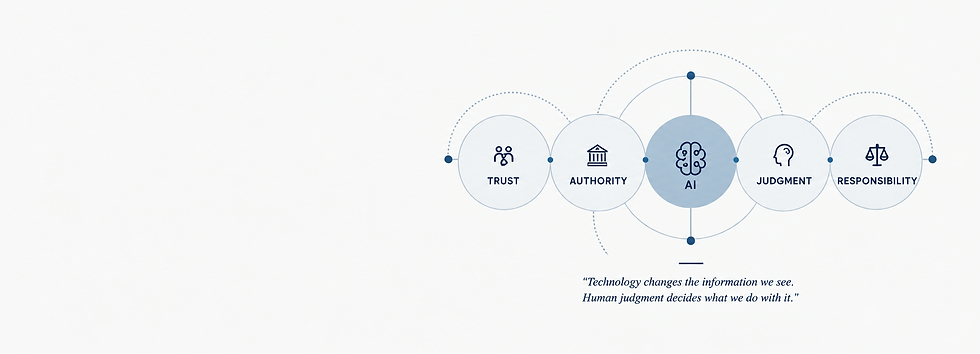
THE QUESTION BEHIND MY WORK
WHAT CHANGES WHEN THE SOURCE OF INFORMATION CHANGES?
I became interested in what happens when people rely on a source they see as knowledgeable or authoritative.
Do they question it?
Do they defer to it?
How does perceived credibility affect judgment?
And what changes when that source is an AI system?
I began with questions about social influence and human judgment. They led me to examine how children evaluate information sources and how AI may influence decisions within institutions.
AN EVOLVING INQUIRY
Two connected journeys show how these questions developed.
JOURNEY 1 — FROM SOCIAL INFLUENCE TO CHILDREN & AI
18 MAR 2026 . GLOBAL ZOOM ROUNDTABLE
HUMAN DECISION-MAKING & SOCIAL INFLUENCE
.jpg)
I convened an interdisciplinary roundtable examining human judgment, social influence, hierarchy, conformity, silence and responsibility in complex institutions.
JOURNEY 2 — FROM AI IN DECISION-MAKING TO AI AS AN AUTHORITY
30 JUL 2026 · ACADEMIC–INDUSTRY ROUNDTABLE
WHEN AI ENTERS THE ROOM
.jpeg)
I conceived, organized and moderated an academic–industry roundtable examining human judgment, responsibility and institutional behaviour when AI enters decision-making.
↓ QUESTIONS THAT LED TO FURTHER INQUIRY
COMPLETED . OCT 2026
CHILDREN & AI
↓ QUESTIONS TAKEN INTO PRACTICE
10 SEP 2026 · PRACTITIONER PRESENTATION
WHEN AI MAKES THE DECISION


Building on these questions, I studied how 108 children aged 7–11 judged whether a friend, Google and ChatGPT could correctly answer questions about the past, present and future.
I brought the questions from the roundtable into a practitioner setting, presenting and discussing them with legal, privacy, governance and data professionals.
↓ FURTHER DEVELOPED THROUGH RESEARCH
COMPLETED. OCT 2026
WHEN AI BECOMES AN AUTHORITY
Together, these engagements informed my 16-page exploratory qualitative paper on perceived AI authority, trust, cognitive delegation, responsibility and dissent.
FEATURED RESEARCH

CHILDREN & AI
CHILDREN’S EVALUATION OF HUMAN, SEARCH ENGINE, AND GENERATIVE AI INFORMATION SOURCES ACROSS TEMPORAL DOMAINS
COMPLETED • OCTOBER 2026 • 25 PAGES • QUANTITATIVE STUDY
RESEARCH BY PARTH PARNAMI
SUPERVISED BY STEVE JOORDENS, UNIVERSITY OF TORONTO, AND FATOS SELITA, HULT INTERNATIONAL BUSINESS SCHOOL, UK
"How do children judge whether a person or a digital source can answer a question correctly?"
I examined this question in an online study of 108 children aged 7–11 in Grades 3–5 at a school in Gurugram, India. Participants evaluated a friend, Google and ChatGPT across questions about the past, present and future.
WHAT EMERGED
Google received the highest proportion of “Yes” judgments that it could correctly answer a question (70.37%), followed by ChatGPT (58.02%) and a friend (33.95%).
Children were less likely to judge a source capable of answering future-oriented questions than past- or present-oriented questions. Age was not significantly associated with their judgments in the fitted model.
RESEARCH INTEGRITY
The study examines perceived capability, not actual answer accuracy. Participants came from one school, so the findings should not be treated as representative of children across India.
THREE WAYS I PURSUE A QUESTION
01 — ASK: RESEARCH
02 — LISTEN: DIALOGUE
03 — CONNECT: INTERDISCIPLINARY WORK
I investigate how people evaluate information, judge authority and make decisions.
I organize conversations that bring different perspectives into the same room.
I follow psychological questions into AI, law/IP and institutional practice.
FROM THE ROOM — 30 JULY 2026
WHEN AI ENTERS THE ROOM
Human Judgment, Responsibility & Institutional Behaviour
Watch two short excerpts from the academic–industry roundtable I conceived, organized and moderated on how AI changes human judgment and responsibility.
